Endolift, up close
Endolift arrives with a tempting promise: the effect of a facelift through a fibre no thicker than a hair, no scalpel, back at your desk in a few days. Part of that is true. The honest version is more interesting — and more useful to hear before you book.
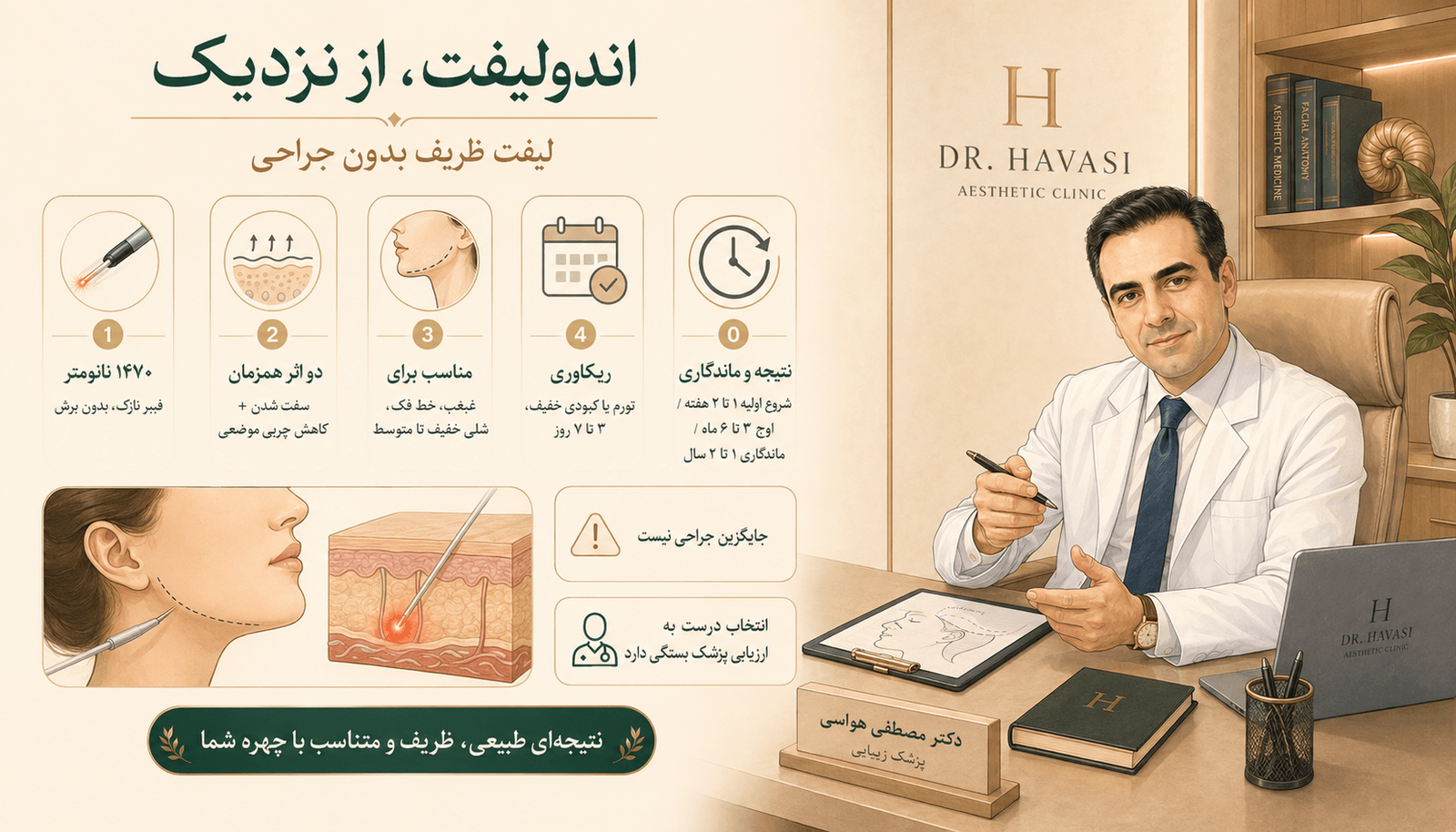
The procedure is elegantly simple to describe. A fibre about the width of a hair is passed under the skin through a single tiny entry point — no incision, no stitches — carrying a 1470-nanometre laser light tuned to the water and fat that sit in the deeper layers. As it moves, it warms the tissue just enough to make the collagen already there contract on the spot, and to coax the skin into building more over the months that follow.
Two jobs at once
That double action is the real appeal. The heat tightens the fibrous scaffolding beneath the skin, and along the jawline or under the chin it can also thaw a small pocket of fat that was blurring the line. It isn’t liposuction, and it isn’t a facelift — but for the right face at the right stage, it reaches a quiet, specific place that creams and even most surface lasers never touch.
It works beneath the skin, which is exactly why the surface is left alone.
You feel little during it; the area is numbed with local anaesthetic first, and there is nothing to remove afterward. Most people report some swelling, the odd bruise, and a firm, tender feeling for three to seven days. You could be back at work the next morning — whether you’d want to be photographed is a separate question, and one worth planning around.
What it can do, and what it can’t
Endolift lives in the middle ground. It is at its best on mild to moderate looseness — early jowls, a softening jawline, a full under-chin, fine crêping — usually in people from their thirties into their early sixties. What it is not is a stand-in for surgery. If the skin has genuinely descended, a laser fibre will disappoint you where a lower facelift would not, and an honest clinic will tell you that rather than sell you three sessions that were never going to be enough.
It also asks for patience. There’s a modest tightening you’ll notice within a week or two, but the real change is slow: new collagen forms across three to six months, and that is when the jawline actually looks cleaner. Cared for, the effect tends to hold one to two years, occasionally longer. It maintains a result — it doesn’t freeze one.
The part that decides everything
With aesthetic lasers the deciding factor is almost never the machine; it’s the hand and the judgement behind it. The same fibre that refines a jawline can, placed without care, thin an area that was quietly holding a face up. So the appointment that matters isn’t the one where we agree to treat you — it’s the one where we look at your skin plainly and say whether Endolift is the right tool at all, or whether your face is better served by waiting, or by something else entirely.
Frequently asked questions
Does Endolift hurt?
The area is numbed with local anaesthetic first, so most people feel only pressure during it, then mild tenderness for a few days.
When will I see results?
A little tightening shows within a week or two, but the real change builds over three to six months as new collagen forms.
How long does it last?
For most people the effect holds one to two years; it maintains a result rather than replacing surgery.
Where can I have Endolift in Karaj?
Endolift is performed by Dr. Mostafa Havasi at the Azimieh clinic in Karaj (with a second clinic in Tehran, Chitgar); a private, no-obligation consultation maps whether it suits your skin.